
My Great-Great Grandparents
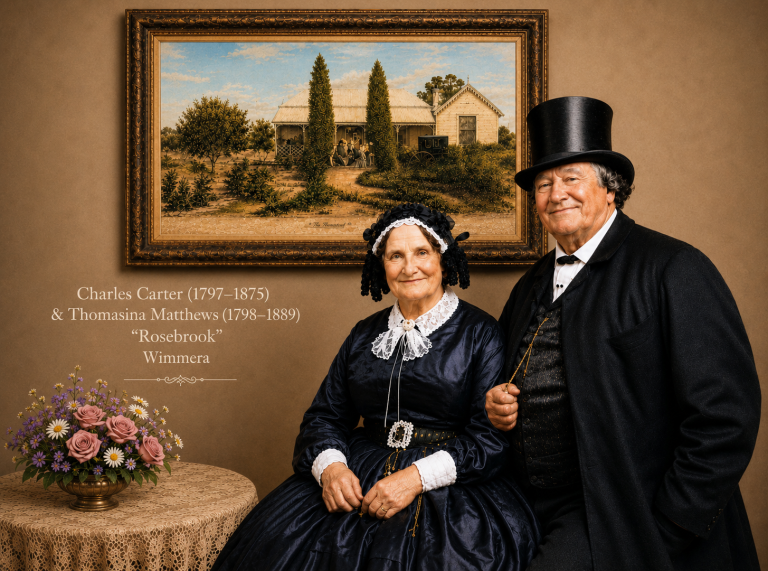
Charles John Carter (1798–1875)
https://adb.anu.edu.au/biography/carter-charles-john-3173Charles Carter
Charles Carter (1797-1875), pastoralist, was born on 1 May 1797 in Cambridge, England, son of Charles Carter, farmer, and his wife, née Barrett. He migrated to Van Diemen’s Land, where on 29 March 1829 he married Thomasina Matthews (1799-1889) who was born at Marazion, Cornwall; they had three sons and three daughters.
After managing a farm at Constitution Hill Carter embarked in 1838 with his family in the Black Squall for Port Phillip, where Superintendent Charles La Trobe later appointed him to make a road to Sandridge (Port Melbourne) and build a breakwater across the Yarra River. He witnessed the riot of two thousand road workers which William Lonsdale suppressed by reading the Riot Act and reducing wages.
In May 1842 he and his family left Melbourne on a nine-week journey with the overlander James Monckton Darlot and his party to drive four hundred cattle and two bullock teams to the unsettled west. By the Wimmera River on 10 August Darlot established the Brighton (Dooen) run of 102,000 acres (41,278 ha). Carter, who managed the station, explored the river with Henry Darlot as far as Lake Hindmarsh.
In October 1851 Carter took up his own cattle run at Brim Springs and later stocked it with sheep. Till 1874 he held this station, and also Rosebrook and Wartook, both of which he bought in 1858 with his sons Samuel, William James and John Charles. Short and rotund in appearance, dour and practical in manner, Carter successfully faced hostile Aboriginals, bushrangers, droughts and bush fires as a pioneer Wimmera settler. He was an Anglican and died on 8 October 1875 at Rosebrook station.
Thomasina Matthews (1799–1889)
https://oa.anu.edu.au/obituary/carter-thomasina-matthews-14506
Our obituary notice to-day contains the news of the death of a very old colonist, and the first white woman who ever came to the Wimmera. Mrs. Thomasina Matthews Carter, at the patriarchal age of 91 years, passed peacefully away to a well-earned rest on Sunday. She died at Rosebrook homestead attended by all her four surviving children. viz: Mrs. Robertson, of Skene, Mrs. Elliott, of Brim Springs, Mr. Samuel Carter, of Walmer, and Mr. William Carter, from Tarrington, Hamilton.
The deceased lady with her husband and family arrived in the Horsham district from Tasmania on August 10th, 1843, to settle at North Brighton, and endured, to the full extent all the hardships, privations and dangers incidental to the settler’s life in the midst of the blacks in those early days. She was accustomed, when the men were away engaged further afield in the bush, to hold the homestead — a log hut loopholed for Musketry fire, and with always a plentiful supply of boiling water for the inimical blacks — sometimes with one of her sons, but frequently without any male protector, and very often she has donned masculine attire and laden herself with provision to take up to the men-folk away at work on the ranges.
Her husband — Mr Charles Carter died in 1875. Ailing, with scarcely any other defined disease but extreme old age, she was found to be failing on Friday and Dr. Cross who was then called in to attend her, announced that the end was near and her children were promptly summoned. Up to the last she seemed to understand what was said or read to her, and her last words assured her people who were gathered round her that she was in “no pain.” The funeral will leave Walmer (where the remains were brought to this morning) at 2.30 p.m. to-day and will pass through Horsham on the way to the cemetery about 3.15 o’clock this afternoon.

My Great-Great Grandparents
James Weatherly (1843–1914)
https://oa.anu.edu.au/obituary/weatherly-james-1015/text1016
The death of Mr. James Weatherly, of Wallaloo Park, Marnoo, on 24th November, removed from pastoral circles of Western Victoria one of its best-known and most respected members. Born at Old Cambus, Scotland, on the 1st October, 1843, Mr. Weatherly was slightly over 71 when he laid down his work. He was educated at Earleston School, and came to the colonies in 1865. He went straight to Queensland, and secured work on Mr. Hood’s Currawinya Station as jackeroo. Two years later he came to Victoria, and except for brief intervals, has been a resident of that State ever since. Mr. Weatherly gained his first local experience on Carranballac Station, and from there went to Mt. William, which property he managed for Mr. Chirnside for six years. The next move was to Mokanger, also a Chirnside property, and this he managed for a couple of years.
Mr. Weatherly launched out on his own account in 1880, when he leased Morven Station from the Bank of Victoria. He purchased Wallaloo Park in 1885, but it was not until ’93 that he went there to live. In 1892 he took a 25-year lease of Hilgay Station, Coleraine.
A large proportion of Wallaloo Park is devoted to cereal growing on the share system, so does not now carry a large head of stock. Hilgay is a sheep property, and runs 14,000 head of Longwools and crossbreds. Mr. Weatherly was a breeder of Lincolns, and was known throughout the Western District as an excellent judge, his services being frequently required at shows in this capacity. Of a kindly, reserved nature, he was beloved by all who came in contact with him. He belonged to the Church of England, and was a great supporter of it in his district, defraying the cost of building the Wallaloo Church Vicarage. A wife and five daughters survive him.
May Bird (1868–1950)
https://adb.anu.edu.au/biography/weatherly-may-isabella-9020
May Isabella Bird (1868-1950), headmistress, was born on 22 May 1868 at Ballarat, Victoria, eldest of three children of Bolton Stafford Bird, clergyman, and his Scottish-born wife Helen, née Chisholm. Educated in Hobart and at Methodist Ladies College, Kew, Melbourne, she matriculated in 1893 and taught at M.L.C. until 1895 when she went to Rockhampton Girls’ Grammar School, Queensland, for a year. Enrolling at the University of Tasmania (B.A., 1904), she taught part-time at Hobart schools while studying for her degree.
Senior mistress from 1904 at Queen’s College, Ballarat, in 1907 May Bird became headmistress of New England Girls’ School at Armidale, New South Wales. Her stay was short: she left after one quarter and, on 16 July, at St Paul’s Anglican Cathedral, Melbourne, married James Weatherly, a Scottish-born grazier of Wallaloo Park, Stawell, Victoria. He was a 63-year-old widower with five daughters, one of whom she had taught and comforted on the death of the previous Mrs Weatherly. When James died in 1914, May returned to Tasmania to stay with her parents on Bruny Island. There she found peace and happiness, and continued to live on the island after her mother and father died.
Having long advocated formal education in ‘home management’, in 1928 Mrs Weatherly left Bruny Island to become the founding principal of a new homecraft hostel which eventually found a permanent location at Invergowrie, Hawthorn, Melbourne. This large bluestone house and extensive garden was presented to the Association of Headmistresses of Girls’ Registered Secondary Schools of Victoria by the family and trustees of the Sir William McPherson estate. May Weatherly had a great rapport with the young and a talent for bringing out the best in them. She ‘guided the hostel through the first difficult years, as perhaps no one else could have done’ and gave professional training to future housewives.
In 1932 Miss Margaret Kirkhope joined her as co-principal and in 1938 Mrs Weatherly retired.
During World War II she took on the voluntary task of organizing a day nursery in South Yarra (sponsored by the Women of the University Patriotic Fund) which provided care for the children of mothers engaged in essential war work. At the request of the Melbourne Technical College, she also prepared and corrected papers for a correspondence course in home-making offered to women in the armed services.
In retirement she lived at Malvern with her sister Ann, widow of Rev. A. H. Garnsey; Mrs Weatherly died there on 2 November 1950 and was cremated. In 1957 the May I. Weatherly Memorial Hall was added to Invergowrie; her portrait hangs in the main house, occupied in the 1980s by the Victorian Post-Secondary Education Commission.

Arthur George Youngman (1855–1934)
https://oa.anu.edu.au/obituary/youngman-arthur-george-15408
Mr. Arthur George Youngman, who died in Hobart on Friday last, will be remembered by many in Launceston. He came to Launceston from Nottingham, England, in the early nineties, and was a teacher of violin and piano, and also an orchestral player for many years before leaving to reside with a member of his family in Hobart.
Arthur George Youngman was born in Nottingham, England, about 1855. He arrived in Australia on the ship Austral in Nov 1889. He was a teacher of violin and piano and an orchestral player. He played the national anthem on the violin during the opening ceremony of the Tasmanian Exhibition in 1891-92 and was leader of the first violins in the Exhibition Orchestra. He was also leader of the first violins of the Launceston Orchestral Society and the Orpheus Orchestral Society and conducted the orchestra for ‘The Muffs’ dramatic club on occasions.
Arthur married Letitia Frances Beck on 1 Nov 1892. They had four children born in Launceston: Eliza Jane, 21 Aug 1893; Arthur George, 31 Aug 1895; Thomas William, 30 Nov 1896 and Bertha Frances, 5 Oct 1900. Letitia died aged 69 on 15 Apr 1929 and was buried at the Carr Villa Cemetery in Section B13 No. 269. Arthur died aged 79 on 17 Aug 1934 in Hobart, and was buried with his wife in Launceston. See The Examiner 28 Jan 2006, p. 25.
My Great-Grandparents
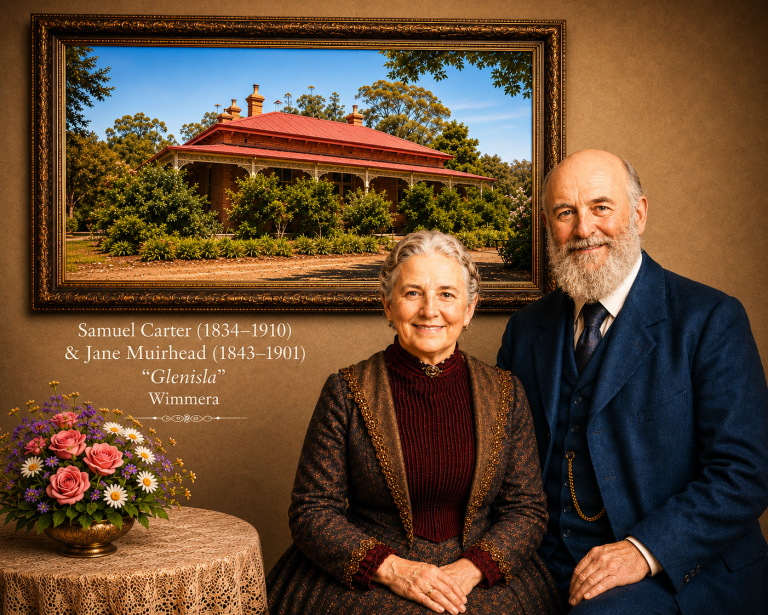
Samuel Charles Carter J.P. (1834-1910)
https://oa.anu.edu.au/obituary/carter-samuel-charles-1620
There passed from the stage of human action on Tuesday morning one who is undoubtedly the oldest resident of the Wimmera — Mr. Samuel Carter, J.P., of Glenisla Station. The late Mr. Carter was one whose history and that of the progress of the Wimmera were inseparable. He saw it transformed from a wilderness to what it is today. He knew the country when it was to many considered a waterless waste, and he had the privilege of living to see it irrigated and smiling from end to end with green fields and pastures.
Until 1901 the deceased gentleman was always a robust man of untiring energy. He was then attacked with diabetes, which ultimately brought on bronchitis. Last year he was ordered to spend the winter in Queensland to try the effect of the warmer climate. He did so, but returned very little benefited by the change. Up to the last day of his life he was quite active, and got about the homestead as usual. He passed away peacefully in his sleep on Tuesday morning, the immediate cause of death being syncope.
Jane Muirhead (1843–1901)
https://oa.anu.edu.au/obituary/carter-jane-14258
It will be learnt with great regret that Mrs. Jane Carter, wife of Mr. Samuel Carter, J.P., of Glenisla Station, one of the oldest and most highly respected of Wimmera residents, died suddenly, at the station, on Tuesday morning. Mrs. Carter had been ailing for only a few days, and although nothing serious was apprehended, a messenger was on Tuesday sent to Horsham for Dr. Ritchie. Before the doctor could arrive at Glenisla Mrs. Carter was dead. The cause of death was heart failure. Mrs. Carter leaves, beside her husband, a family of six, three sons and three daughters. Two other children pre-deceased her. For the bereaved family the greatest sympathy is felt.
The deceased lady, who at the time of her death was 58 years of age, was a native of Scotland, and had resided in the Wimmera for upwards of 40 years, of which 35 represented her married life at Glenisla. She was before her marriage a Miss Muirhead, sister of the Messrs. Theo. and Alex. Muirhead, who many years ago had the Mount Elliot Station. Subsequently Mr. John Muirhead, since deceased, was manager of Walmer Station, and Mr. Alexander Muirhead, who now has a valuable station property in Queensland, managed at North Brighton.
Mrs. Muirhead, Mrs. Carter’s mother, died at Glenisla, where she had lived for some time, about 25 years ago, and is buried in the Horsham cemetery. The funeral took place yesterday afternoon, the interment being made at the Horsham cemetery, and was largely and representatively attended. The pall-bearers were Messrs. John Carter, J. G. Carter, S. C. Carter, T. R. Elliot, Robt. Elliot and John Elliot. The Rev. Thos. Gray conducted the service at the grave and the funeral arrangements were carried out by Mr. W. F. Allan.

My Grand-Parents
William Charles Carter, (1867–1941)
https://oa.anu.edu.au/obituary/carter-william-charles-1618
The death occurred Wednesday night at a private hospital at Rupanyup, after ten days illness of one of the Wimmera’s oldest residents in Mr. William Charles Carter, of “Wallaloo Park”, Marnoo, aged 74 years. Mr. Carter’s grandfather came to the Wimmera as early as 1841 and took up grazing, selecting land at Glenisla, between Horsham and Cavendish, also North Brighton (near Dooen) and Pine Plains in the Mallee. He was the first to select land in the Wimmera-Mallee area, following Major Mitchell’s exploration of the country. Deceased’s father, Mr. Samuel Carter, was only eight years old when he arrived in the district. He was a respected resident and had a large influence in the advancement and progress of the country. He was the main mover in the construction of the Wartook reservoir, which was his own idea. As a member of the Wimmera Shire Council he met considerable opposition, but this he successfully overcame, and the reservoir was constructed to the perpetual benefit of landowners and all residents in the Wimmera. He also had experiences with bushrangers.
Deceased was the eldest son of Mr. and Mrs. S. Carter and was born on the Glenisla Estate. He, too, followed successfully in pastoral pursuits, and carried on the high traditions of the family. In the year 1918 he married at Wallaloo Miss Marjorie Weatherly whose parents were also land pioneers and took up country in this district 57 years ago, coming from the Western District, where Mr Weatherly was a pioneer. The late Mr. Carter divided his time between his properties at Glenisla, “Glenwood” near Dooen, Horsham, Longerenong, Drun Drun, and Marnoo.
Deceased was highly esteemed and was of sterling worth. He was a respected and valued member of the Presbyterian Church and always took an interest in all charitable institutions and organisations for the benefit of the district. His passing has removed another pioneer, and sympathy has been expressed to his widow and her two sons, Alex and James (above). The funeral will take place at the Horsham Cemetery to-day, leaving the Presbyterian Church at 3 o’clock.
Mary Anna Marjorie Weatherly (1884–1967)
https://oa.anu.edu.au/obituary/carter-mary-anna-marjorie-15387
Marjorie Carter was born in 1884 at “Morven” station, Branxholme, Victoria, fourth daughter of James Weatherly (1843–1914), one of the earliest landowners of western Victoria, and third daughter of his second wife Jane Wilson (1844–1905). She was raised at “Wallaloo Park” near Marnoo with her four sisters Agnes Millicent (b. 1877, unmarried), Eloise Florence Elizabeth (b. 1881, d. 1952, Mrs J. S. Gregory, “Longerenong”) Frances (b. 1882, Mrs O. Esperson) and Isabella Grace Harriet (b. 1887, d. 1946, unmarried).
Marjorie was educated at the Church of England Girls’ Grammar School, Ballarat. After their father’s death in 1914, she managed “Wallaloo Park” with her sister Isabella. On 26 November 1918 she married William Charles Carter (1867–1941), of “Glenwood”. The couple relocated to “Wallaloo Park” in 1920 and raised their sons Alexander James Weatherly (1920–2011), and James Samuel (1922–2000).
Marjorie died in 1967 at Rupanyup, Victoria. She was from a line of writers whose ancestry dates back to Sir Thomas ‘The Rhymer’ of Ercildoune, believed to be Scotland’s earliest poet and prophet. He predicted the sudden death of King Alexander III of Scotland and Kinghorn on 19 March 1286 (Kinghorn is the name of Marjorie Weatherly’s grandmother). Publications by Marjorie include the novels The Keys of Heaven (1918), Australia’s Child (1951) and A False Balance (1955), and poetry including Contrasts (1925), Voices from My Garden (1928), To My Sister (1948) and Fragments (1950).
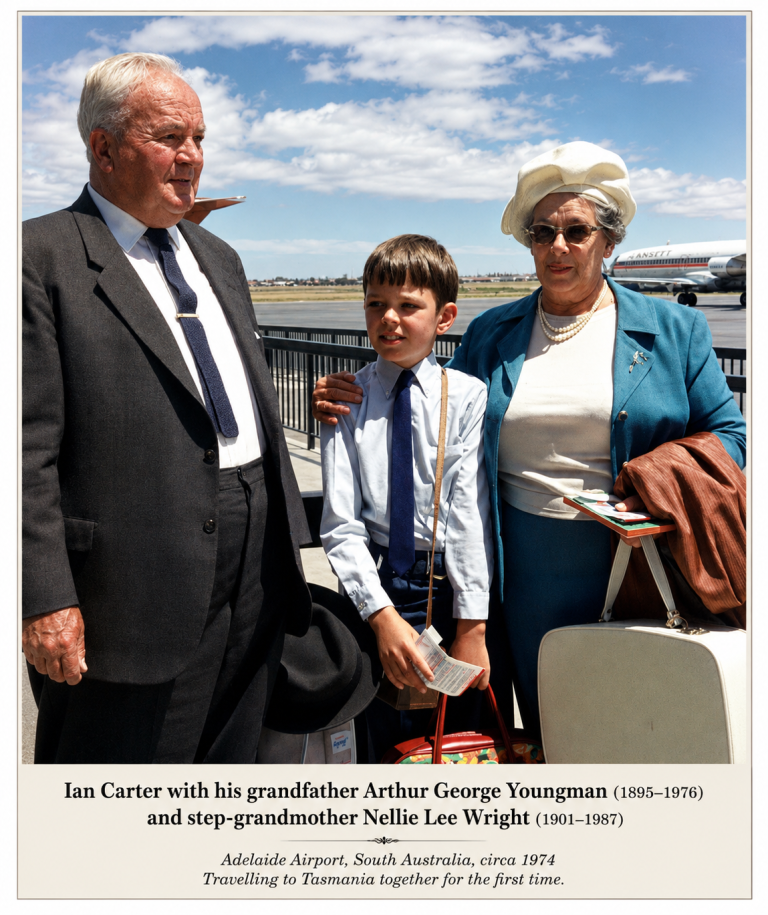
Arthur George Youngman (1895-1976) &
Nellie Lee Wright (step) (1901-1987)

My Parents
James Samuel (Jim) Carter (1922–2000)
https://oa.anu.edu.au/obituary/carter-james-samuel-jim-15259
James (Jim) Samuel Carter was born on 29 Dec 1922 at the family estate ‘Wallaloo Park’, Marnoo, Wimmera, Victoria, second son of grazier William Charles Carter (1867 – 1941) and Marjorie Weatherly (1884 – 1968). He was raised on the estate with his brother Alexander James Weatherly Carter (1920 – 2011), and attended primary school at Wallaloo East.
Jim attended Brighton Grammar (1936-39), matriculating as dux of the school and a Prefect. He was also a member of the Editorial Committee of the Brighton Grammarian, and a member of the football, cricket, and tennis teams.
In 1940 he began a Bachelor of Mechanical Engineering at Melbourne University and on 8 Oct 1941 enlisted in the Melbourne University Rifles (MUR). He transferred to the Australian Infantry Forces on 24 Mar 1942, overstating his age to the required 21 years. After basic training at Puckapunyal, he was posted to Rum Jungle in the Northern Territory, Brisbane, Queensland for Artillery Fire control training and then Sydney harbour heads Artillery installation.
After demobilising, Jim returned to Melbourne University and completed his Engineering degree. He also re-joined MUR and rose to the rank of Captain.
After graduating, he joined the Melbourne City Council, and supervised construction of the Lonsdale street power station chimney in 1953, which was known as “Jimmy’s chimney”.
Jim then travelled to Great Britain and Europe. Upon returning to Australia he joined P.A. as a management consultant and there he met his future wife Noelle Youngman (1927 – 1999), secretary to the managing director. They married in 1957 and moved to Berwick where Jim was working for Heinz. They bought land and intended to raise their family there.
In 1958 they moved to Adelaide where Jim joined Cresco fertiliser as general manager. In the early 1970s he moved to Horwood Bagshaw agricultural machinery as general manager. In this role he travelled widely including Libya, Europe, USA, UK, the Middle East, and Asia.
In 1976 Jim established his consulting firm, J. S. Carter and Associates, offering management advice and recruitment services.
In the early 80s, Jim and Noelle divorced and he returned to academia. He studied at various universities including Flinders, Adelaide; James Cook, Townsville; Bellingham, Washington State, USA; and in Singapore and India, completing three postgraduate qualifications in statistics, sociology and psychology. He travelled across the USA by Greyhound bus, and was once stranded in Harlem, New York City, but used his natural charm to safely return to lower Manhattan.
A qualified glider pilot, Jim also played golf, tennis and squash and enjoyed music and dancing at the family home he designed on “Grenache” avenue “Wattle Park”, Adelaide, located opposite “Penfolds” Magill Estate. Noelle was an accomplished piano player and singer, and their home was built for parties. They hosted annual New Year’s Eve parties, and barbecues around the swimming pool. He and Noelle had 4 sons, Bruce James 1958, Peter Robert 1959, Ian Charles 1961, and David William 1963.
In later life Jim resided at North Terrace, Adelaide, and worked on his Ph.D. Thesis on “subjective well-being” (happiness).
A gentleman and scholar, Jim was loved deeply by all his extended family and friends. He died on April 1, 2000, true to his credo “Life’s a joke and all things show it, I thought so once and now I know it”.
Jim’s ashes were interred at the family memorial in Horsham, Victoria, where the Carter family first settled the Wimmera in 1842.
Noelle Youngman (1927–1999)
https://oa.anu.edu.au/obituary/carter-noelle-15398
Nöel (Noelle) Youngman Carter was born on 21 December 1927 in Burnie, Tasmania, daughter of Mr. Arthur George Youngman (son of music professor A. G. Youngman) and his wife Ruby Madge nee Allan (sister of Sergeant David Allan, M.M., K.I.A. France). She was raised and educated in Burnie and Launceston and commenced a career in dental nursing, moving later into business adminstration. She was also a highly talented musician both as a vocalist and on piano, and entertained at parties around Tasmania.
In the mid 1950s Noelle moved to Melbourne and was secretary to the managing director of P.A. Management Consultants, where she met and married James Samuel Carter in 1957. They moved to Adelaide and raised a family of four sons, Bruce James (b. 1958), Peter Robert (b. 1959), Ian Charles (b. 1961) and David William (b. 1963). They regularly entertained local and international guests at parties at their house in Wattle Park designed by Jim.
Noelle later returned to a career in business administration and held positions including executive secretary with the Adelaide Convention Bureau, and secretary to the Headmaster of St. Peters School Collegiate. After her retirement she travelled widely across the Asia-Pacific region. She died in Adelaide in January 1999 and was survived by her husband, sons and brother, David Charles Youngman (b. 1933).
